Welcome to Catnapin's
Setting Up the Show
Cretaceous Room
*****************************************************************
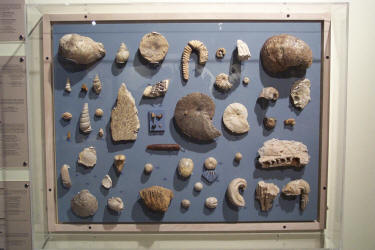
Wall Mounted Case of Sea Creatures
on lone from Jo Cox, Judie Ostlien, Don Brenholtz, and Hardin-Simmons University
(Many are from or near Taylor county)
(prepared, identified, and mounted by Jo Cox)
*****************************************************************
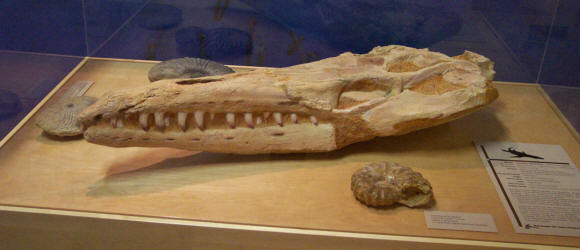
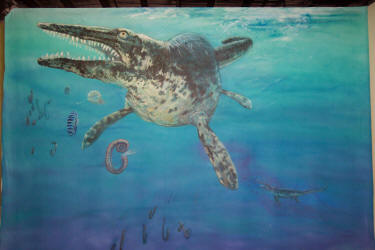
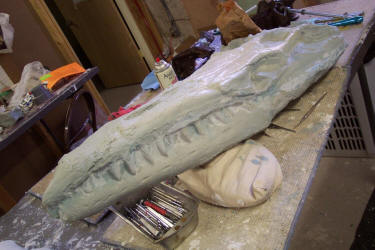
Tylosaurus nepeolicus & Ammonites
on lone from Ken Barns - replica scull - cast by the Boneheads (from Terlingua Texas)
on lone from Hardin-Simmons University - several ammonites - (from Texas)
Mural painted by LaGina Fairbetter
*****************************************************************
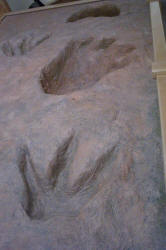
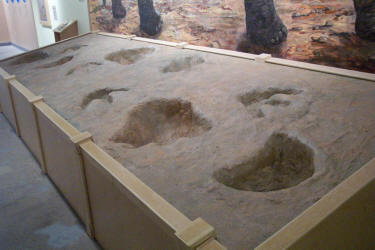
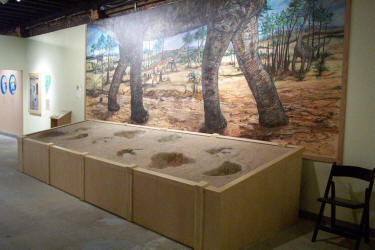
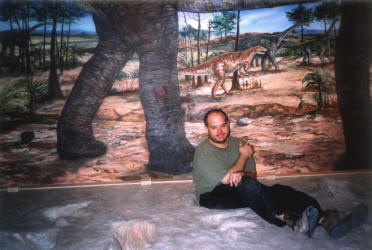
Paluxy River Trackways
Early Cretaceous 113 Ma
Display was designed, built, and installed by John David White
A 20 foot mural painted by LaGina Fairbetter depicts the full sized legs of Pleurocoelus.
Beyond is a stalking Acrocanthosaurus and a watchful Iguanodon.
Pleurocoelus: (PLUR-o-SEE-lus) Sauropod, 50 ft long, 80,000 lbs.
Acrocanthosaurus: (AH-cro-CAN-tho-SAW-rus) Theropod, 35 feet long, 12,000 lbs.
Iguanodon: (e-GUAN-o-don) close cousin of the Hadrosaur, 30 ft long, 10,000 lbs.
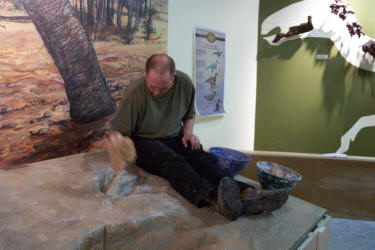
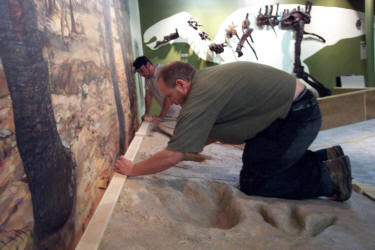
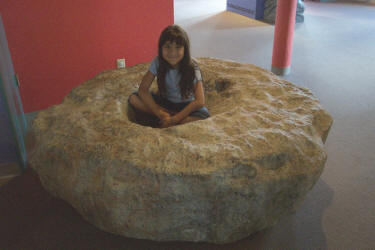
Single Pleurocoelus footprint placed in children's room.
Designed, built, and installed by John David White
|
Trackways Trackways are actually quite common. They come from all periods of time and all sorts of animals. How do we know which animal made the tracks? Paleontologists study foot bones of fossils to determine size, shape, and stride. They also study living animals. Current footprints show how hooves, foot pads, and claws compress mud. Then the best candidate fossil is chosen as a match to the footprint. The Tracks Tell a Story Once upon a very long time ago, dinosaurs lived near a limey mudflat close to a shallow inland sea. A herd of Pleurocoelus strolled across, their feet sinking deep into the soft mud, unaware of danger. Stalking them, an Acrocanthosaurus, walked, crouched, and ran, hoping to catch a meal. Nearby an Iguanodon watched both animals carefully, as it nibbled delicate ferns. Soon afterwards another layer of mud gently filled the prints, preserving them. Many layers covered the first. After millions of years, the calcium carbonate in the lime consolidated (cemented) forming limestone. Each layer contained different amounts of minerals, making harder and softer layers of stone. Millions of years passed again. In 1908 a huge flood ripped through the Paluxy River removing several feet of stone and exposing the lower limestone prints. The river will continue to erode the limestone tracks until none are left. To preserve the existence of this wonderful story, paleontologists have removed some of the tracks. You can see a long series at the Texas Memorial Museum at Austin. Or go to Glen Rose to see the prints for yourself. Mistaken Identification In 1909, while wandering in a tributary of the Paluxy River, a teenager discovered giant turkey tracks. A local teacher had heard of tracks from New England and correctly identified these as dinosaur. The next year two more teenagers found tracks in the River itself. Accompanying the three-toed tracks were oblong tracks 15 to 18 inches long. The boys described them as “giant man tracks.” In the 1930’s, locals cut out and pried up slabs of tracks to sell as curiosities. One resident sold oblong “man tracks”. But carving loose slabs was much easier than raising actual prints from the riverbed. He added details not found in the originals to make them look more human. These people were not promoting a scientific or theological agenda. They only wanted to feed their families during the Great Depression. The first paleontologist to look at the tracks, R. T. Bird, arrived in 1938 after seeing a few carvings in New Mexico. He found no human tracks but could not explain the oblong impressions. He also discovered much larger tracks, belonging to a Sauropod. While three-toed Theropod tracks had been seen before, this was the first report of Sauropod tracks. Those supporting “man tracks” have misquoted his writings and used photos of the carved footprints as proof of humans living at the same time as dinosaurs. Ironically, one of the main groups to publicly dispute the oblong tracks as human came from a team of Creationists. They called some of the prints dinosaurian digits, others erosion oddities. They found no evidence of human trackways. They noted that many of the “man tracks” had actually been highlighted with oil to make them more humanlike. No reputable researcher has ever found credible “man tracks” at the Paluxy River. The three-toed tracks are accredited to Acrocanthosaurus, a common Theropod of the Early Cretaceous. In hunting, Acrocanthosaurus used different modes of locomotion. Scientists can tell if the animal was walking or running by the stride of the three-toed footprints. The oblong tracks belong to this animal also. Like birds, Theropod dinosaurs walk and run on their toes with the ankle and smallest toe held off the ground. In 1979, G. J. Kuban concluded that the oblong tracks show a new way of walking. Here the weight of the animal rests on the ball and heal of the foot instead of the toes. In the oblong impressions, shallow toe marks and the smallest toe can often be distinguished. Why would a Theropod do this? Was it for better traction in the mud? Or did the animal crouch low while it stalked its prey. |
*****************************************************************
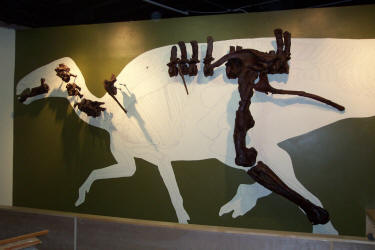
The Boneheads Hadrosaur
Edmontosaurus sp.
excavated and cast by the Boneheads - thanks for the lone of bones by Ken Barns - (from Terlingua Texas)
mounted replica
_small.jpg)
*****************************************************************
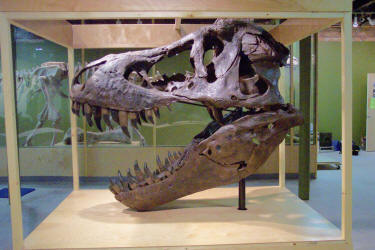
Tyrannosaurus rex
replica of skull - on lone from George Blasing (Dinosaur World)
_small.jpg)
*****************************************************************
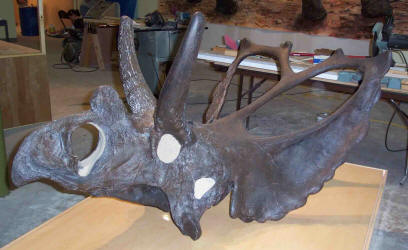
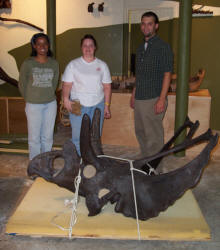
Chasmosaurus mariscalensis
cast of scull - on lone from Texas Memorial Museum at Austin (from the Big Bend of Texas)
*****************************************************************
Deinosuchus antirrhopus
reconstructed scull - on lone from Texas Memorial Museum at Austin (from the Big Bend of Texas).
(sorry none of the photos came out)
*****************************************************************
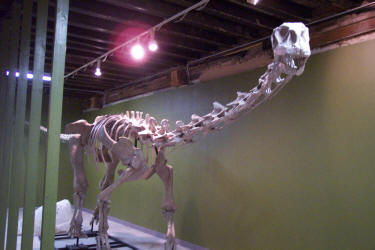
Malawisaurus dixeyi
mounted replica - on lone from Dallas Museum of Natural History
(not from Texas, but a representative sauropod that just barely fit into the room)
_small.jpg)
*****************************************************************
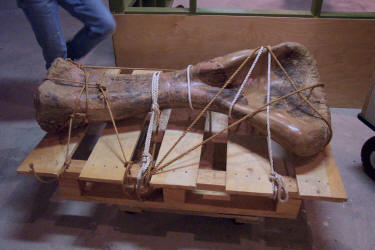
Alamosaurus sanjuanensis
humerus - on lone from Texas Memorial Museum at Austin (from the Big Bend of Texas)
_small.jpg)
*****************************************************************
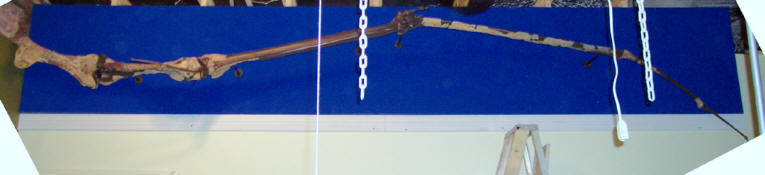
Quetzalcoatlus northropi
reconstructed mounted wing - on lone from Texas Memorial Museum at Austin
*****************************************************************
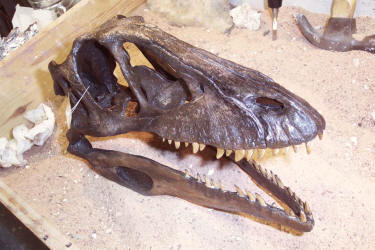
Deinonychus antirrhopus
purchased replica of skull - on lone from Scott Clark
_small.jpg)
*****************************************************************
Email fossilcritter"at"catnapin.com
to reduce spam, change "at" to @
please be specific
Copyright Notice: All photos are copyrighted and protected by the laws of the United States.
Unauthorized duplication for sale or distribution is prohibited.